Previous featured guests include:
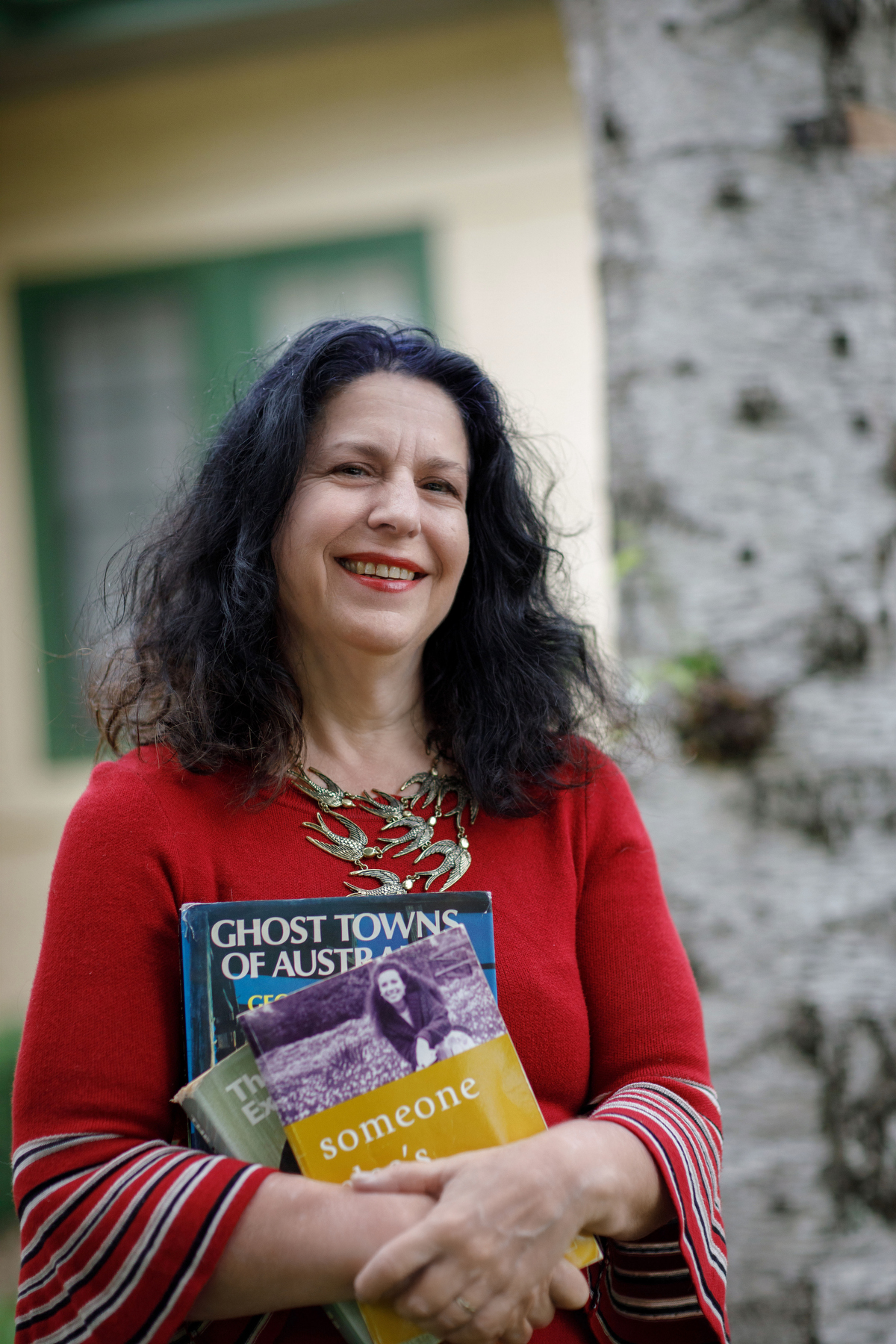
A few questions… with Kaaron Warren
1. What pathway led you into being a writer?
I was pretty focused on becoming a published writer from very early on in my career. Long before I sold a single story, I was sending out requests for guidelines, in the days you had to physically mail a printed letter! I had a loose-leaf folder full of markets, with notes as to what stories I might send them. I have an early issue of the horror magazine Bloodsongs, published firstly in Australia and then the US, with an interview with Ellen Datlow. I adored her anthologies and would devour her Year’s Bests, reading every story, noting down what I liked and didn’t like, what worked as horror for me. In the interview she mentioned an anthology of revenge fiction. I circled this! And I wrote a story called ‘A Positive’ to send to her. She didn’t take the story but gave me a really encouraging note, with a point of editing that made a lot of sense. I sold that story to Bloodsongs instead, and it went on to win me my first Aurealis Award in 1998.
All that is to say: the pathways are not always clear and laid out for you. They’re often strewn with debris of discarded stories, and harsh rejections. Although I’ve only truly received one harsh rejection, all them hurt to this day! But mostly the rejections are polite, and either generic or encouraging. This one said something like: ‘The publisher really loved this story but I hated it. It didn’t make sense and I think you are a terrible writer.’ Ouch! But also: The other person loved it, so that’s what I took away from that letter!
I’ve written since I was about 7 years old. Taken it seriously since about 15. I still take it very seriously, and still love what I do. I’ve taken opportunities and invitations when they come my way as often as I can, and tried to support others in the community.
2. What (or who) have been the influences over the years as you developed your voice as a writer?
I’m a voracious reader, as many writers are. So my influences are wide and varied. As far as developing my own voice though, that’s all me. It’s many hundreds of thousands of words on the page; it’s working hard to make sure that each idea I have for a story is thought through, so I don’t end somewhere predictable or inevitable, but somewhere that surprises me. It’s observing, listening, keeping notes, being curious about everything and everyone. It’s not losing that sense of wonder.
3. Are there any particular themes that you like to explore in your writing?
Family, responsibility, crime and punishment, violence and its repercussions, love, loss, grief, fear, the afterlife and what might come next.
4. Do you have any particular process when you begin a new work?
I start by brainstorming ideas and thoughts, handwritten, usually on a series of notebooks and scraps of paper. The handwritten nature of it is part of the process; it helps me think. I doodle, colour in letters, draw arrows from one thought to the next.
I’ll do some research to start the story off, get the feel for it. Often this will lead to rabbit holes I find it hard to get out of, so I take notes all the way, trying to keep the end result (that is, the story) in mind.
I’ll try to find a particular piece of music that suits the work, something that I can play to put me into the right/write place. The novel I’m nearly finished has Season of the Witch as its theme song!
Once a certain ‘ping’ goes off in my backbrain, I know I’ve gathered enough information and thoughts, and it’s time to get to work. If I haven’t found the story’s voice by then, I’ll work at a few pages, coming at it from different angles, until the right voice presents itself.
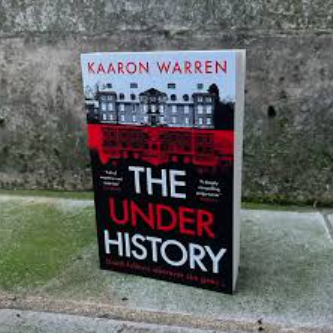
5. I’ve bumped into you a few times at AsylumFest, the horror festival at an asylum. What draws you to such dark things?
I’ve never really been able to answer this question. I’ve been drawn to dark things my entire life, from the moment I could read. I liked the scarier fairy stories, the ghost stories, the tales of the graveyard. I remember being only about 5 years old and learning there were actual dead bodies buried in a cemetery and being both aghast and utterly fascinated.
My mother was cross at me about a Mother Theresa quote she’d written up as inspiration. ‘It is better to light a single candle than to curse the darkness.’
I took the words ‘curse the darkness’, one of the first titles that sprang out at me, and thought, how can I get something dark and scary from an inspirational quote. I never did write that story! I have the title written down, and I think a couple of lines somewhere. Actually, when I think about it, this will be the PERFECT title for the haunted house story I’m working on.
I guess the dark side has unknowns, mysteries and puzzles that fascinate me. There are so many possibles, so much room for the imagination. And people who are drawn to these things are often very open to ideas, and so at somewhere like AsylumFest, you can spend the weekend talking about ghosts, inspirations, loss, ideas, anything at all.
6. And, finally, describe your ideal writing space!
I have trained myself to be able to write anywhere, rather than using my environment as an excuse not to write! That said, I have an office in our house which is piled with papers and notebooks, research books, weird items to inspire, all that kind of thing.
I love to get away on a writing retreat with friends and spend the days writing, the evenings eating and talking.
But to be absolutely honest, my perfect writing space is a hotel room. A nice one is great, but even a small one works. Just me, a desk or table of some kind, probably true crime or some kind of crap on the TV. My laptop, my notebook and a series of pens. And nothing else. I’m at my most focused at these rare times.
A few questions… with Geoff Brown

1. What led you to studying professional writing and editing? Tell me a little about your experiences there.
I was studying a Diploma of Community Care to become a drug counsellor but, due to issues within the course, ended up swapping over to start the two-year Diploma of Professional Writing and Editing. I was already working on a memoir of my years of substance abuse and the resultant lifestyle, which was finished and released during my Cert. IV year at Bendigo TAFE.
I really enjoyed the course in its entirety and managed to achieve HDs and Ds throughout, as well as being named Vocational Student of the Year and overall Student of the Year after finishing my second year at TAFE.
The classes and teachers were fantastic. It was great to be surrounded by such creative staff and students, even though many students wouldn’t go on to achieve all their capability in the industry – mostly due to the vagaries and barriers within the industry itself.
Towards the end of the first year, I began a freelancing business offering editing and proofreading services, especially within my much-loved speculative fiction field, as well as design options and book layout in digital and print media. I’d spent the previous 10 years networking and publishing within the horror genre, meeting readers, writers, artists and publishers. This network helped when I started writing and submitting short stories, and helped even more when I started the service business within the field.
During the second year of study, I created Cohesion Press, a small press focused exclusively on action-based speculative fiction. We’ve released 13 editions of SNAFU, our military horror-themed anthology, with #14 on the way, and we’ve sold many short stories contained within the volumes to Netflix for the much-loved and critically-acclaimed Love, Death + Robots series, conceived by Hollywood creators Tim Miller and David Fincher.
Having a short story published within the SNAFU series has helped many of our authors move into sales of work for adaptation by Netflix, one of the premier streaming and content creation companies in the world. Some authors have also moved into working behind the scenes with Blur Studio, the company owned by Tim Miller.
2. Horror seems to feature heavily in your writing and editing work. What draws you to the horror genre in particular?
Hell, I’ve loved horror, sci-fi and fantasy as far back as I can remember. Book series like Robert Arthur Jr’s Alfred Hitchcock and the Three Investigators and movies/TV like The Exorcist,Carrie,Salem’s Lot,Trilogy of Terror and all the other classic horror from the 70s and 80s first made me explore the concept of having the shit scared out of me. I found I enjoyed it, and then there was no going back.
I think horror has the ability to make us look inside ourselves, offering the chance for personal growth without real danger, and at the same time reflects the societal fears of the Zeitgeist of the times. From the radiation/mutation of natural order-fears of the 50s, such as Tarantula and Them!, to the fear of violent crime and the monster that is man of the 80s onwards, such as Halloween and Friday the Thirteenth.
3. Are there any particular themes that you like to explore in your writing?
My writing is mainly for fun: my own and my readers. With 11 short stories published by presses located in Australia, the US, the UK and South Africa, some multi-published, I’ve built a name for gritty horror and humour, as well as startling reality in Hammered: Memoir of an Addict.
Having survived childhood abuse and a staggering part of my life filled with drug abuse, these themes at times appear to some extent within my writing. The need for society to better deal with mental health, abuse and drug use is a passionate ideal for me, and I’ve written many articles for regional and metro newspapers on the subject.
4. Tell me about the formation of Cohesion Press and its success.
Well, Cohesion first existed as the name of the freelance editing business I started towards the end of my first year at TAFE. At the time I was reading more and more action horror, as well as military memoirs and fiction. I said more than once to my wife that there just wasn’t enough to read in the action horror genre, to the point she just looked at me one night and said to just start publishing it myself.
From that chance remark grew Cohesion Press, a well-respected small press with a focus on what I personally liked to read. It took a year to put together the call-out for the first SNAFU, which unlike later volumes had no real theme outside of military horror. I knew some well-known and respected writers, so we had the idea to solicit four tales and have open submissions for the rest. We promised the solicited big names a share of income for the volume, hoping to have their marketing machines spread the word to their fans, who I believed would happily become fans of Cohesion once they saw what we were releasing. It seemed to work too.
From that first SNAFU, more were released. I knew Amanda Spedding, who would become our editor-in-chief, through being a part of the committee for the Australian Horror Writers Association, now the Australasian Horror Writers Association. Her work ethic, experience and prone-to-hijinks nature ensured she would fit in well.
We started releasing novels and collections, and ended up with at least 15 releases other than the annual SNAFU anthologies, with some quite big names in the industry contracted with us.
We eventually had to make the hard decision to draw back from any releases other than SNAFU once our other business, ghost tours and paranormal investigations within a decommissioned 1800s asylum we own in NE Victoria, really took off and ate up so much of our time. We felt it wasn’t fair to the authors if we didn’t give 100% of our time to them, so we released all from contracts and readjusted to a much smaller output.
We’d been contacted back in 2017 by Blur Studio and Tim Miller regarding selling rights on behalf of the authors for some SNAFU short stories to be adapted to the small screen through Netflix. It was such an exciting time, but we were forbidden from saying anything until it was officially announced by Netflix, and the poor authors had to hold their tongues even longer on being involved because Netflix wished to keep the content under wraps until release. It nearly killed me not to scream from the rooftops just what was happening.
I ended up working for Tim, reading shorts to find him more stories to consider because, as he put it, ‘I haven’t come across anyone with taste like mine when it comes to that action horror goodness.’ Other writers whose stories sold ended up receiving contractual work with Tim’s company, and it was so damn good seeing that happen. We started Cohesion for two things: to give me more things to read, and to help our authors on their journey, and both are paying out in spades.
We continue to work with Tim to this day, and he was even a guest via Zoom from LA at our inaugural AsylumFest in 2022.

5. Has your writing or editing transformed or been influenced since you started running the Beechworth Asylum Ghost Tours?
My entire life has been transformed by starting the business here. I was teaching part-time at Bendigo TAFE in the course I’d finished three years prior. The inimitable Tom McWilliam – our editing teacher when I studied – retired and told the course coordinator that I would be the best choice to replace him. I was honoured to fill that gap, although I could never fill his shoes. I spent two years there, then we received the phone call offering us purchase of parts of the asylum and exclusive rights to run ghost tours there.
We’d been on the tours, and knew what was required, but had little experience in running a tourism business. We gave it a go, and ended up doing much better than the previous company.
Because of that, I find little time to write and submit these days, although I’ve been solicited for anthologies a few times, so was forced to push myself to write.
My editing has always been as meticulous as I could possibly be, with a focus on horror without working exclusively on that genre.
I’ve worked on all kinds of speculative fiction, as well as non-fiction, YA, as well as scholarly works.
Now, I have no time for editing (I will run an eye over things my friends ask me to) although I’m happy to do book layouts. I still have the software for desktop publishing, and I love that creativity as much as I love writing. I still create all the marketing imagery for Cohesion Press, Asylum Ghost Tours, and the newest venture, AsylumFest. It saves us a fortune on graphic design, and I like to think I do pretty well.
6. And, finally, describe your ideal writing space!
A protected yet still outdoor office area, like an internal courtyard with protection from adverse weather, a beautiful water feature trickling like a creek through landscaping, with some soft music playing (I tend to avoid lyrics while writing or editing) and a coffee machine in the corner.
That sounds ideal to me!
Geoff Brown
Geoff is an award-winning Australian writer and Australian Shadows Award finalist-editor raised in Melbourne’s gritty Western Suburbs. He is a trained nurse and holds a Cert. IV in Professional Writing and Editing, as well as a Dip. Arts (Professional Writing and Editing).
Geoff writes fiction across various genres and is the author of many published short stories. He’s had numerous articles published in newspapers, both regional and metropolitan.
He is the past president of the Australian Horror Writers Association (2011–2013), as well as the past director of the Australian Shadows Awards.
He owns Cohesion Press, an award-winning Australian publishing house focused on fast-paced military horror, and currently works with Tim Miller, director of Deadpool and creator of the Netflix Original™ series Love, Death + Robots, as a senior story consultant.
He is also the co-owner of Asylum Ghost Tours and co-creator of AsylumFest, an annual horror pop-culture festival held in a decommissioned 1800s asylum.
A few questions… with Michael McGinty
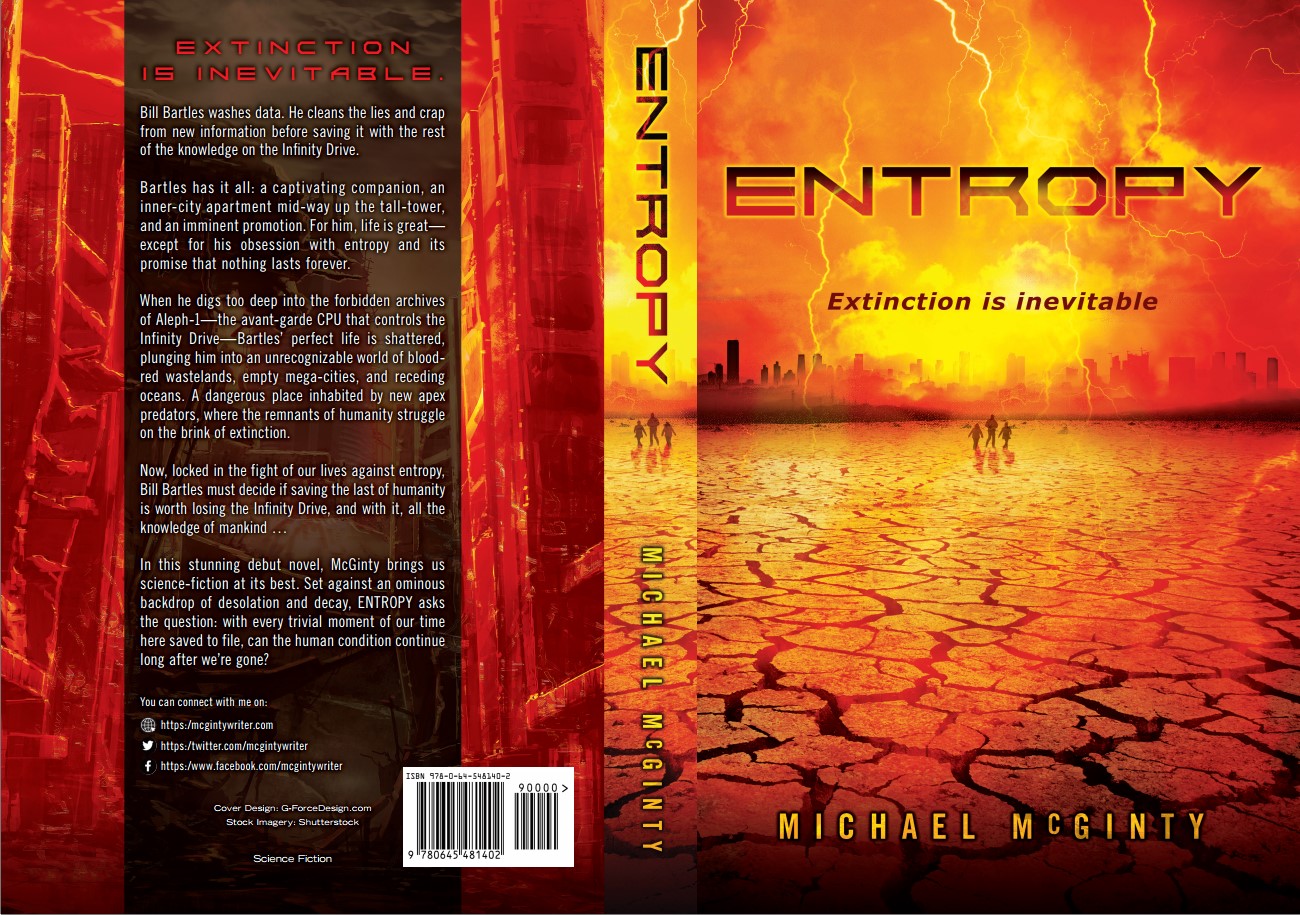
I had a chat with Michael McGinty about his recent sci-fi book Entropy – which I was involved with assessment and editing. Entropy can be found here.

1. Entropy sits firmly in the science fiction genre. Who have been some of your favourite authors and inspirations in science fiction over the years?
My love of science fiction started when I read Ray Bradbury’s Fahrenheit 451 as a teenager. Back in the 1970s it was mind-boggling futuristic and I was amazed by its daring premise.
I’m not a profuse reader, but I do read widely. Over the years, I tended to enjoy authors like Arthur C Clarke, Bradbury, Asimov, Frank Herbert, Hugh Howey, Liu Cixin and Tolkien. The ideas in their stories fascinate me. The story of Entropy is greatly influenced by the imagination of Philip K Dick along with Neuromancer by William Gibson, Dark Matter by Blake Crouch, and my favourite novel The Road by Cormac McCarthy.
Stephen King says, ‘If you want to write, you need to read.’ I think he’s right. Other people’s stories provide the inspiration and road map that a new writer requires. For example, the scene where Mr Symons goes on a rant to Bill Bartles was inspired by Beatty’s rant to Montag in Fahrenheit 451. There’s much in Entropy where I thought: How would Blake Crouch write this? Or can I out-neuromance William Gibson? Or how would PKD leave nuance here?
2. Are there any particular themes that you like to explore in your writing?
I love stories that deal with the resilience of the human spirit against unimaginable odds. When all is lost, will the characters we’re rooting for survive? The Walking Dead TV series is a great example of that. It was a challenge for me to write a story about the end of humanity, where everyone dies, yet try to leave a glimmer of hope.
Entropy is primarily about the massive amounts of data we’re creating every second of every day. The 1s and 0s that are filling the storage devices. Collectively, it represents the entire knowledge of humankind. Although considering social media and disinformation campaigns, can it be trusted? Would it represent a reliable account of our time here if it were discovered by some archaeologist 1000 years from now?
I also love prose. It probably comes from writing sci-fi poems when I was younger. In Entropy I’ve tried to immerse the reader in the broken world Bill Bartles finds himself in by describing it. In the ‘Can you hear loneliness?’ scene, I tried to describe nothing by describing what wasn’t there. Some people don’t like exposition; however, one reviewer of Entropy says ‘McGinty’s stoked imagination provides many powerful and beautiful scenes’ which I take as a huge compliment to the way I wanted to tell the story.

3. Does your engineering background and knowledge feature in your stories?
Definitely. I like hard science fiction. It ties in well with my profession as a hardware/software engineer. Write about what you know. So I try to incorporate hardware and software into my writing. Entropy even has a few pages of defragmented sentences (to replicate the way data is actually stored on a hard disk) as well as some C software programming syntax, which I included as a bit of fun.
The AI known as Aleph-1 and the Cantor Infinity Drive were also conceived based on engineering, scientific and mathematical concepts. I can still remember the day our mathematics lecturer told us students about imaginary numbers. ‘You’re kidding,’ we all protested. But, yes, there are imaginary numbers, so they warrant a mention in the story as well.
4. What inspired you to write Entropy?
I’ve always enjoyed writing short sci-fi poems. I like the way the words come together to evoke emotion in the reader. One day I decided to write a novel. What could be easier? Eight years later, after joining writers’ groups, trawling the internet for advice on how to write, meeting many like-minded people and editing and re-editing, I finally had a finished story.
Hard sci-fi is difficult to write. It has to be precise, propose scientific theories, discuss physics and mathematical concepts, yet be entertaining. I could have picked an easier genre, but I wanted to write something that I would enjoy as a reader.
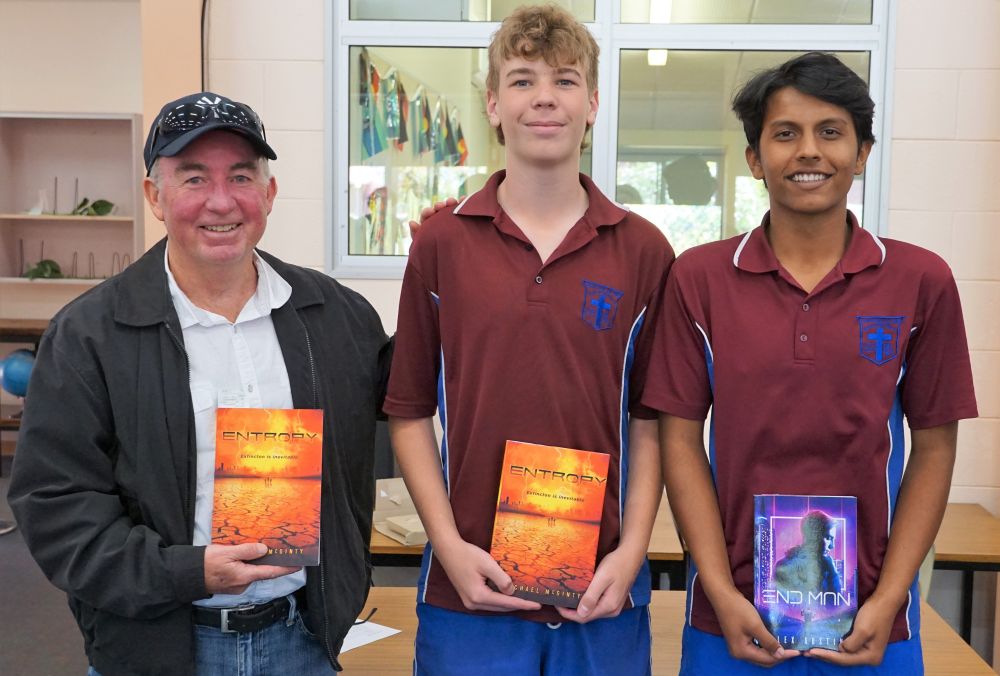
During a recent visit to my hometown high school in Kalgoorlie, one of the students asked me if I ever felt like giving up?
I said, ‘No, I never give up.’ Whether Entropy is successful or not, I’m happy because I never gave up.
5. What have you learned through self-publishing Entropy?
Self-publishing has been an enjoyable experience. I tried to go the traditional route. However, when COVID-19 hit, it upset everybody’s publishing plans. I figured with the technology readily available it’s easy to self-publish, but I had to have a quality product, inside and out. If I learned anything, a book must have a well-designed cover and be professionally copyedited.
The copyediting process was my biggest learning curve. It’s daunting for any debut author. First, you need to find an editor you’re comfortable with, then you need to trust them. Scott Vandervalk did a fantastic manuscript assessment first up, which gave me the confidence to have him continue with the copyediting. And I’m very happy with the result.
And marketing is hard for a debut author. How do you get your name out there as a serious writer? Never give up.
I’ve met many wonderful people who gave me support and advice along the way. I think everyone who contributed to Entropy (whether beta reader, advice giver, cover designer, editor, a tireless marketeer) has some ownership of the end result. I hope everyone involved feels the same satisfaction as I do.

6. And, finally, describe your ideal writing space!
I’ve written Entropy almost everywhere. At a desk in my study. Out on the patio with my mate (dog), Louie. Sitting in my car in a park or by the seaside. In libraries, including the local library and the State Library Victoria in Melbourne. Many ideas come to me while I’m out walking. These are the hardest because I have to keep repeating them in my head until I get back to my laptop.
Michael McGinty
Mike was born and raised in Kalgoorlie, in the goldfields of Western Australia. He moved to Perth in the late 1970s to study a Bachelor of Engineering (Electronics) at Curtin University (or WAIT in the olden ☹ days).
With a good science fiction novel in hand and a life-long passion for technology and innovation, he always imagined a future for humanity built around technologies that might seem impossible today, yet possible when we think about tomorrow. When not writing, Mike runs a software development company (www.cyinnovations.com), loves 1970s heavy rock music and cheers on his beloved West Coast Eagles AFL team. He often goes fishing in the Australian never-never.
Mike lives in an empty nest in Perth with his wife and their sidekick, Louie, their black labrador.
Mike can be found at mcgintywriter.com / Michael McGinty at Goodreads / Twitter / Facebook.
A few questions… with Patrick O‘Duffy
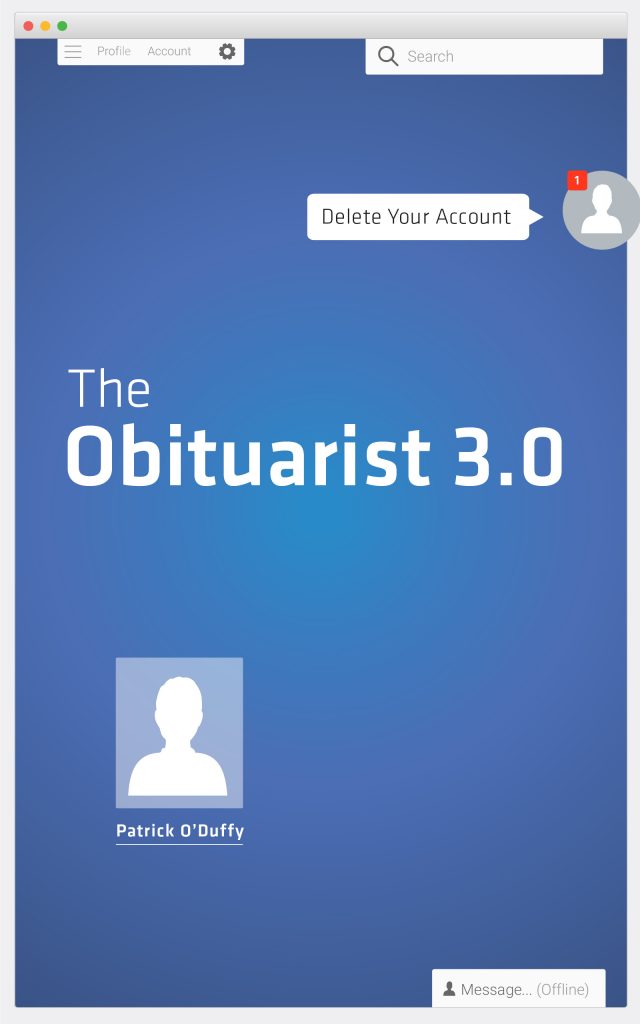
I had a chat with Patrick O’Duffy to ask him a few questions about writing, gaming and self-publishing. His latest book The Obituarist 3: Delete Your Account, an oddball crime story, can be found here and here.

1. What was your first published piece of writing?
It was a short story in my high school yearbook, but let’s not count that. Or the occasional bits of fiction and reviews I wrote for my university’s student newspaper. That was all more like typing practice than writing.
The first piece of published writing I’m prepared to own up to was an essay about emphasising the consequences of characters’ actions/decisions in roleplaying games, which came out in the Hunter: The Reckoning Storytellers Handbook in late 2001. I have only rough memories of the essay, but I’m pretty sure it wasn’t ground-breaking – or particularly good. Still, it was enough to get my foot in the door, and I made a solid part-time career out of game writing for the next 5–6 years. Eventually I got better at it.
My first published piece of fiction writing was a short story called ‘Seven Down’ and was about a man repeatedly stabbing himself. (It was cleverer than it sounds, honest.) It was part of a ‘Mini Shots’ concept/series by a small Melbourne publisher – individual short stories published as pocket-sized pamphlets, cheap and ideal for reading on public transport. ‘Seven Down’ came out in September 2007; Amazon released the Kindle two months later and that pretty much killed the notion of printing individual stories in hardcopy. So it goes.
2. Are there any particular themes that you like to explore in your writing?
I’ve always got some theme in mind when writing fiction, but I’m not trying to make the same particular point in every story. Except… as I thought about this, I realised that maybe I do – and it might be the same point that I struggled to articulate in that 2001 gaming essay. If I have a signature theme, it’s perhaps that actions have consequences. There are potential repercussions to any action – big or small, well-intentioned or otherwise – and characters either do something in response or become part of the problem.
There’s a lot of plot fodder in exploring or reflecting consequences; even small, personal ones can have impact on the small, personal parts of the story. They’re a big emotional hook for my characters as well. Some regret their past actions and are trying to make amends; some were hurt by others’ actions and have to process their anger or sadness; some know they’re making things worse for themselves but feel they probably deserve it. It’s cheery stuff!
All that aside, I like to write horror and weird fantasy, stories that suggest ‘normality’ is a thin and easily damaged disguise covering up a bizarre, dangerous or illogical world. I don’t know if that’s a recurring theme or just part of working in that genre space. And I often try to write stories that are hopeful to some degree, in which the characters do manage to deal with consequences, make amends for their mistake, help others and generally make a difference. Because I think that’s possible in the real world as well, if we make the effort.
Huh. Turns out I was totally wrong about this whole ‘not exploring particular themes’ thing. Good to know.

3. What have you learned through self-publishing some of your work?
That self-publishing is hard, man!
I worked in the publishing industry for years. I understand the time, effort and expense that goes into creating and selling any book, and for some reason I decided to forget all of that when I started publishing some of my work as ebooks in 2011. I just jumped in feet-first without a plan and, surprise surprise, I didn’t do a very good job of it! I was disorganised, I had no business plan, I didn’t promote my work effectively – I treated it as an adventure or an experiment, not a professional act of publishing, and that meant that very few people read my books and I’ve made very little money from them over the years.
I’m not alone in this, of course; Amazon was deluged in self-published books once their systems went live, and while that initial tidal wave has fallen back a lot since then, there are still enormous numbers of them coming out. And to be clear, I don’t think that’s a bad thing. Self-publishing is a hard thing to do well, and a very hard thing to make money from, but not every writer cares about that; they care about telling the story burning inside them, to the best of their ability, and putting it out for the world to discover. That passion is worth respecting, even if it doesn’t fit the definitions of ‘success’ that capitalism tells us are important.
That said, I’ve met a number of writers who are successful self-publishers, and without exception they are incredibly hard-working and professional about the business of not just writing but of editing, publishing, marketing, design community management, self-promotion and everything else. They are dedicated and driven, I admire them enormously – and I’m not like them. I’m glad they keep the majority of their royalties; they deserve it.
Me, I will happily give away 80–90% of my writing income to anyone who will do all the hard stuff for me. Interested? CALL ME.
4. You’ve recently finished writing The Obituarist series. Tell us about the series. What inspired the books?
The Obituarist series is a trilogy of crime novellas about a ‘social media undertaker’ – someone who cleans up and closes down the online presences of the recently dead. This is important work, both for the emotional and personal aspects but to prevent identity theft and other forms of fraud. Okay, that might not sound terribly exciting, but the books also include action, mysteries, swearing, violence, sarcasm, scary men with guns, weird crime stuff I found online, snappy dialogue and a moderately dodgy protagonist.
As for what inspired the series… Facebook, for the most part. It didn’t have clear policies in the early 00s about what to do when users died, so their pages would be left uncontrolled or get taken over while their friends were grieving in the comments. That seemed like an interesting and fast-changing situation worth exploring through fiction, and genre stories are a great opportunity to explore real-world situations at a slight distance. I considered some fantasy and horror directions, but quickly saw the potential for a slightly oddball crime story, one that built on my love of Raymond Chandler’s writing while having its own distinct, modern voice. And because this all comes back to how our society deals with death, the books dig into that theme I unpacked earlier – the lingering consequences of our actions, the things the dead leave behind for the living, the regrets we carry with us and the things we do because of those regrets.
Okay, now these books sound very serious. They have fun stuff too, I promise. And they’re cheap!
5. What have you learned about telling stories from gaming?
Lots of things – pacing, world-building, describing action in an engaging way, tailoring a story so that it better connects with the audience, how small ideas can still provide a core around which to build bigger and more complex ideas… I could go on. But I won’t, because I don’t think my experiences are true for everyone; gaming (i.e. roleplaying, Dungeons & Dragons, etc.) is a very individual and idiosyncratic thing, and people get different things from it. I think many writers could find things in gaming that help their craft, but they’ll be different things than those that help me, and some writers won’t find much or any value in it.
If there’s one (almost) universally valuable thing about gaming for writers and storytellers, it’s that your audience is right there, sitting with you and engaging directly with your imagination and your ability to craft a story. If your ideas work, they will tell you immediately; if there are conceptual gaps, or your story is unengaging, or your characters don’t pop, you know right away. That’s true whether you’re playing the game or in charge of it, whether the game directly references a story/concept you’re writing about or is about something totally different. That immediate, interactive audience is like a mirror being held up to your work, your storytelling craft, and reflecting both its strengths and weaknesses directly back at you. That’s a great learning opportunity, and the main reason I recommend more writers give it a try. And it’s fun, too.

6. And finally, describe your ideal writing space!
I really only need three things:
- A computer that runs Word (no, not Scrivener or Open Office or whatever) and lets me access the internet for research purposes, but with no video games and a block on all forms of social media.
- A chair with strong lower back support, because I am tall and old and everything hurts now.
- A large and terrifying gentleman who takes away my phone, checks on me every hour and delivers credible threats of horrific violence befalling me should I fail to meet my daily wordcount goals.
They’re simple things, but all that I really need in order to do my best writing.
Maybe I should try crowdsourcing them.
Patrick O’Duffy
Patrick O’Duffy is a writer and editor from Melbourne. In addition to his work for RPG publishers such as White Wolf and Green Ronin, he’s the author of the weird fantasy Hotel Flamingo and The Obituarist series of offbeat crime novellas. He’s currently working on a couple of YA fantasy adventure novels and waiting for the world to stop being so… so everything, you know? His website can be found here.
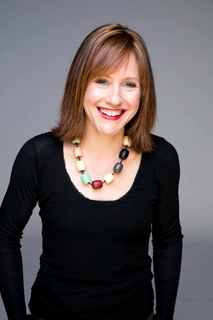
A few questions… with Madeleine D’Este
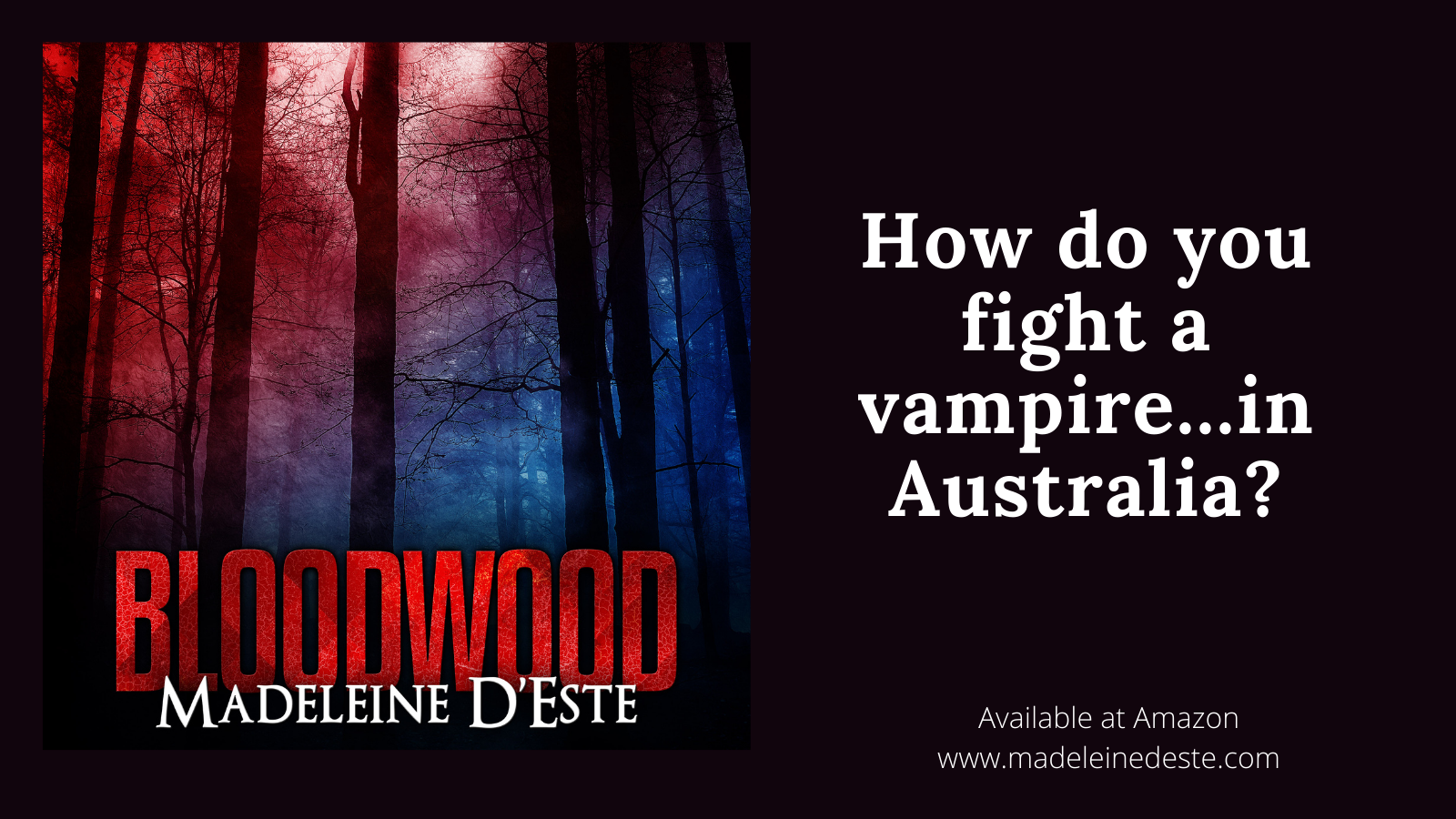
I had a chat with Madeleine D’Este recently to ask her a few questions about her writing. Her latest book Bloodwood, an Australian vampire horror story, is out now and can be found here. (Note: I had the pleasure of editing Bloodwood for Madeleine.)
When and how did you make a start in writing?
I got serious about my writing about 6 years ago. I spent many years failing at writing, doing courses or Nanowrimo but never taking it further than a shithouse first draft. Then one day during a period of some serious navel-gazing (maybe it was a mid-life crisis), I realised that the one thing I wanted to do in my life was write a book. So I got stuck into it and finished it. And then I finished another book and then another. It’s completely addictive – making up stuff is the best fun in town.
Are there any particular themes you like to explore in your writing?
There are three particular themes that crop up constantly in my writing: the paranormal, redemption and cake.
I’ve always been attracted to the darker side of life (and death), and my redemptive stories come from the realisation that we humans make mistakes – some massive and life-altering – but I believe we can dust ourselves off and begin again.
Now that was deep. On the other hand, I’m not sure why there’s always cake, but who doesn’t like cake? And I do love to write a decadent food description. I blame Enid Blyton and her midnight feasts for that.
Which authors do you love to read?
Where do I start? I’m a serious bookworm and host a weekly book review radio show ‘Dark Mysteries’ on www.artdistrict-radio.com.
Just as COVID-19 struck, I bought 45 vintage Agatha Christie paperbacks off eBay and I’ve been working my way through them. She’s just remarkable, a plotting genius. I read a lot of crime fiction and most of the time I guess the ending but never with Aunty Agatha. She always thwarts me in the last few pages
Other writers I love include Shirley Jackson, Alison Littlewood, Erin Kelly and Michael Robotham. My ideal book is spooky, dark and twisty, a story that keeps me guessing.

What inspired you to write Bloodwood?
It was a dark and stormy afternoon, when the Winnebago broke down in a small town in southern New South Wales. While stranded, I picked up a cosy mystery from the nearest café book-swap. The book featured an eco-friendly undertaker (like Shelley in Bloodwood) and I was reminded of a story a friend told me about how the current body preparation process used in funeral homes is actually used to prevent vampires (removing blood and heart, etc.).
Then I got a case of the good old writer’s ‘what-ifs?’ What if an eco-friendly funeral director really did accidentally create vampires? … and Bloodwood was born. I also have an interest in folklore and wanted to explore some of the earlier superstitions about vampires, not only the Bram Stoker version. For example, in the opening scene of Bloodwood, there are a few ‘bad omens’ that contribute to the creation of the vampire: tears are shed on the burial shroud and a crow flies over the body.
Are there any characters in Bloodwood you feel you’re most like?
Obviously, the main character Shelley. I can be a bit aloof at times and self-sufficient to the point of pig-headedness. I was a chubby teen goth, so Sparrow too, and I hope one day to be a feisty old lady like Thora – but hopefully without the drinking problem.
And finally, tell us about Folklore Thursday!
Folklore Thursday began as a hashtag on Twitter on Thursday to promote all things folklore run by Dee Dee Chainey and Willow Wisham. Every Thursday there’s a topic and thousands of people share snippets of interesting folklore from around the world. Ever since I stumbled across the hashtag, I’ve been an avid contributor and through the community, I’ve learned so much about the stories we’ve told and superstitions we’ve held for millennia. I’m such a big fan, I have the t-shirt. I’ve also written a series of articles for Folklore Thursday on the origins of common superstitions such as opening an umbrella inside or leaving shoes on the table.
Madeleine D’Este
Madeleine D’Este is a writer of dark mysteries from Melbourne. Growing up in Tasmania, obsessed with books and the shadows at the end of the bed, Madeleine now writes female-led speculative fiction. Her supernatural mystery novel The Flower and the Serpent was nominated for the Australian Shadow Award for Best Novel 2019. When not writing or reading, Madeleine enjoys podcasts, knitting, forteana, indie films, kettle bells and coffee as ‘black as midnight on a moonless night’. Her website can be found at madeleinedeste.com.
A few questions about… with Les Zig
I had a chat with Les Zig recently to ask him a few questions about screenwriting. This interview originally published in the Bendigo Writers’ Council Muse News July 2020 edition.
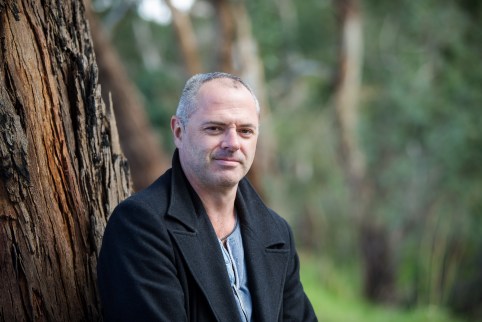
Les Zig is the author of The Shadow in the Wind (Pinion Press 2019), August Falling (Pantera Press 2018), Just Another Week in Suburbia (Pantera Press 2017) and Pride (Busybird Publishing 2017). His stories often focus on characters facing adversity who are trying to find their place in the world. He’s had three screenplays optioned, and 20 unproduced screenplays place and shortlist in various awards. His stories and articles have been published in various print and digital journals. He blogs, often yelling at clouds, at www.leszig.com.
How did you get your start in writing and getting published?
I got my start the way most writers do – through reading. I loved reading as a kid. I loved opening a book, and that feeling that from the first page that the story was going to take me on an adventure.
I wanted to write stories, and give other readers the same feeling. There’s also something magical and empowering about a creation that’s limited only by your imagination and your ability to articulate your vision.
I handwrote my first book as a 16–17-year-old – part one of an intended four-book fantasy epic. That book would be awful if I looked at it today, but these stories taught me about the endurance needed to write a novel. But I wouldn’t be published for 30 more years, although I had lots of almosts.
What it really comes down to is perseverance. You will get rejections. You will get criticisms. You will have doubts. You’ll fall out of love with your book. You’ll grow to hate it. It’ll bore you. It’ll frustrate you. You’ll want to ditch it. All this is normal. The only way you’ll ever get published is if you persevere.
What are your influences in your writing?
In prose, my three biggest influences have been JRR Tolkien, JD Salinger, and David Eddings – all authors I read when I was young.
JRR Tolkien taught me about world-building. When you read The Lord of the Rings, every character has a backstory and lineage. Every location they visit has history that stretches into antiquity. It gives that world unbelievable depth, which is why I think it’s endured as a fantasy classic – it feels so real.
JD Salinger and David Eddings both taught me the same thing: about keeping my prose simple. Because I grew up on a lot of fantasy, I was reading lots of formal prose with weighty descriptions. Both Salinger and Eddings had a more conversational tone, which I found truer to how I wanted to write.
In screenwriting, William Goldman (All the President’s Men, Butch Cassidy and the Sundance Kid, Misery, The Princess Bride) is my favourite writer. He had such a great handle on storytelling, whatever the genre.
In filmmaking, Steven Spielberg is another who’s always appealed to me. Often, his films are about epic events – aliens landing, dinosaurs running amok, archaeological treasure hunts, etc. – but he always a find way to ground the story and keep it relatable and believable within the universe he’s created.
What makes screenwriting different to any other writing?
Screenwriting is a visual medium. You have to think about what the audience is seeing, and how to communicate everything through that filter.
In prose, a character can sit in an armchair, think through a situation, and come to some conclusion. We read what’s going on in their head. But imagine that on screen. It’s not going to be very exciting. So how do you translate that scene in a way that the audience is going to find engaging? (Obviously, you could use a voiceover/narration, but that’s considered something of a cheat, unless you do it well.)
Prose is a cerebral medium. Screenwriting is a visual medium. What works in one won’t work in the other, so you’re always forced to think innovatively.
What’s the process of taking a screenplay and getting it to the screen?
In some ways it can be similar to publishing: you submit to a production company, and if they’re interested they take it on, and move forward to make it. That would involve revisions; getting a director on board; the pre-production of finding locations, rehearsals, casting; shooting; editing; marketing – and that’s offering an abbreviated look at what’s needed.
The difference worth noting immediately is that while a novel is an individual’s vision – and a good editor will help the author realise that vision – a screenplay becomes a collaborative process as other people get involved, such as a director, a producer, a script editor, the actors, the studio, etc. Everybody has input.
However – and, again, like publishing – in Australia, a lot of companies aren’t open to unsolicited submissions.
That leaves the alternative of trying to make something yourself – like self-publishing. Then you’re wholly in charge of the project, who you bring on board, who you cast, etc. But then you face the same query that a production company would – money. Unfortunately, Australia’s arts community is always impoverished, and it’s a struggle moving forward.
The other worthwhile thing to do is network. Join the Australian Writers Guild (the guild for screenwriters) for example, and network with other professionals. You might find a director looking for a particular story, or you might be able to pitch an idea. There are no guarantees obviously, but it’s important to put yourself out there.
What makes a good story in any medium of writing?
The most important thing for me is the journey the character takes – not so much the physical journey, but who they are when they begin the story, and who they are when they end it.
Luke Skywalker is an example in the Original Trilogy. He’s just a kid with dreams who’s thrown into a galactic conflict. He has adventures, he fails often, but he grows as a result. The Luke at the beginning of A New Hope is impulsive, callow, and short-sighted. The Luke at the end of The Return of the Jedi is measured, composed, and able. While we’re not battling galactic turmoils, we can relate to his journey of somebody who wants to get to a better place.
But it doesn’t always have to be a good place. I love Michael Corleone in The Godfather movies. A child born into a mob family, he wants something different for himself. A war on the family forces him to take a stand. While he holds onto the ideal of becoming somebody better, he also embraces the cruelty of his world and thrives in it. You can see he enjoys the power, and leaves behind the idealistic young man who returned from the war wishing for an honest life.
I love seeing characters change – especially when they’re coming from humble beginnings, or are against the odds. While we have our skilled heroes – like James Bond – I think the story’s always more satisfying when it’s the every-person who evolves into something greater, because it’s a reflection of ourselves as we move through life.
What is your best tip for getting into screenwriting?
The obvious tip is to be educated to do it – there are good courses you can find. But, like prose, the thing you can do is immersion: watch how television shows and movies operate. Read scripts. There’s a great website called ‘Drew’s Script-o-Rama’, which has scripts from a lot of movies – even earlier drafts that had been abandoned.
Watch the best storytellers and how they build stories, characters, and events. While I’m biased towards the 1970s and 1980s, there are so many good movies from that era that are educational: The Godfather and The Godfather II, A Dog Day Afternoon, Jaws, Rocky, Superman, The Verdict, Kramer vs Kramer, A New Hope, The Empire Strikes Back, E.T., Back to the Future, Raiders of the Lost Ark, Poltergeist, etc., that introduce an interesting premise and then build on it.
I’ve always thought the three best genres to watch in terms of world-building are courtroom dramas, horror movies, and sporting underdog stories. In today’s action movies, there’s a tendency to just throw as much action at the screen as possible at the sacrifice of world and character building.
A courtroom drama has to build both sides of the case, introduce stakes, and have a logical, cohesive argument that works its way to its conclusion. A good horror is always a slow build up to get us to care about the characters, meet their world, and then be aghast when it goes awry. The sporting underdog story is simple: an underdog individual or team battles the odds to get to a big contest.
I think those three genres – when done well – have an inherent structure that needs to be employed for them to function. They always set their characters on a journey, start them somewhere basic, and then have them encounter obstacles, grow from their encounters, and then end the story in a different place to which they started it.
A few questions about… with E J Dawson
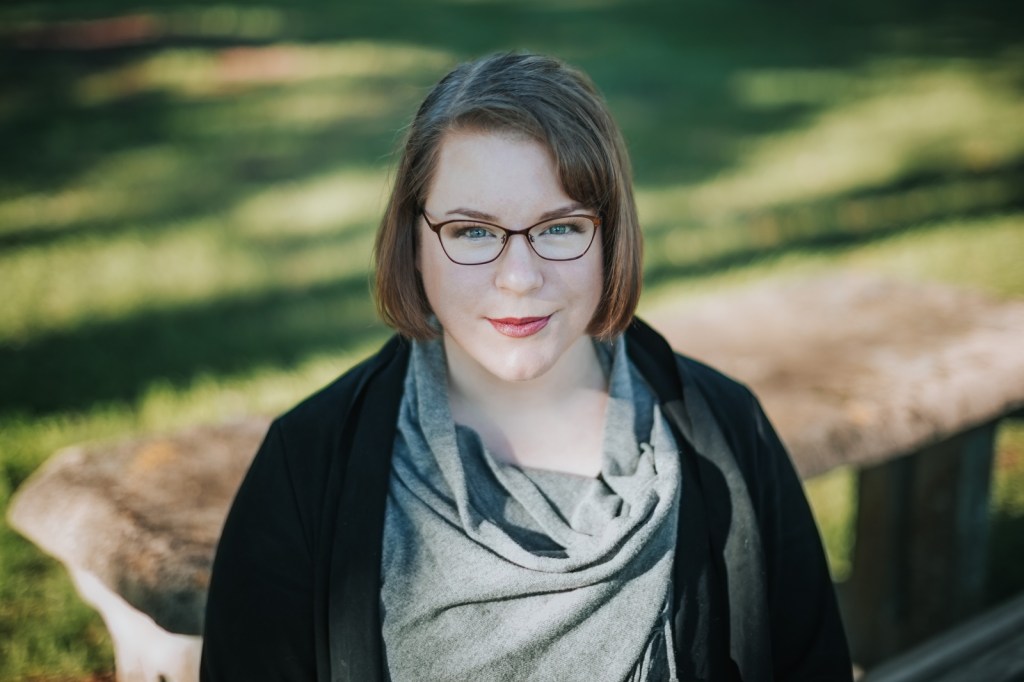
Beginning a writing journey with an epic 21 book series, Ejay started her author career in 2014 and has taken on the ups and downs of self-publishing with her fantasy series The Last Prophecy since 2016. At the start of 2019, she put the series on the backburner to write Behind the Veil in 25 days, and signed a publishing contract for the gothic noir novel to independent publisher Literary Wanderlust. Believing in more than one path to career in publishing, Ejay pursues self-publishing alongside querying traditional publishers with multiple manuscripts.
How did you get into self-publishing?
When I turned 30, I was incorrectly informed I wouldn’t be able to have children. It was a crossroad that forced me to ask myself what I wanted to get out of life, if it wasn’t family. I turned to the one thing that made me happy: writing. What eventuated was a convoluted steam-flavoured fantasy but, realising it was a rather large series that would take 10 years to publish, I knew I had to self-publish. I wasn’t scared, but I was nervous. The more I looked into it the clearer the idea of self-publishing became.
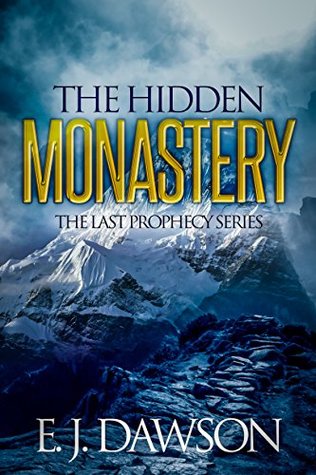
At the time I joined Nanowrimo, an international writing challenge, one of the prizes for which was with the beta publishing platform Pronoun. It assisted with the self-publishing process completely, made everything incredibly easy for me, and I learned a lot from them. When I was ready – after much of Scott’s help – I self-published The Hidden Monastery, the first novella in a 21 book/novella series called The Last Prophecy series.
I went on to add another novella and a book to that series and self-published them before Pronoun shut down. I’m now using Amazon KDP (Kindle Direct Publishing) and Draft 2 Digital, which reaches other platforms such as Barnes & Noble, Kobo, iBooks, and a few others.
What are your influences in your writing?
I draw heavily from my environment and music. Random things come to my mind, so I carry a notebook with me to write them down as they come to me. The more you get into a habit of doing this, the more notebooks you have. (I have three active ones for different genre projects.)
The important thing is to find things you must write. It won’t always be the case – you have to make a habit of writing, as with any other craft. Once you’re used to writing regularly, it becomes a necessity to do. I find that sometimes a story will wrestle me to the computer and compel me to finish it. I wrote such a story in 25 days – Behind the Veil, a gothic noir – coming in at 80K words. I was later offered a publishing contract from Literary Wanderlust, a small independent US press.
Are self-published books saleable and how do you promote them?
Any book is sellable. The difference is whether self-published work sells compared to a traditional book, and the answer is yes, provided you produce a quality piece, and do the necessary work to promote it.
With all the control over your marketing, budget, and growth, you can do it easily, but there is a lot more give than take for some time to start. For example, many authors have the freedom to give their book away for free. You may think that’s selling yourself and your work short, but with a new book being published every 5 minutes on Amazon, you have to be very competitive. There are tips and tricks to doing this, but what I can tell you is no one method works. It takes consist work over long periods of time, and requires a huge amount of commitment. You are your own publisher, marketer, designer, accountant, street team, social media manager, website manager… the list is endless.
What you can do though, is make these things simple, and there are heaps of people willing to help.
Are there any good resources to access to help with self-publishing?
Given the growth of self-publishing over the last 10–20 years, it has caused a host of problems and then their solutions. I sincerely recommend a few different resources, one of which is Alli – the Alliance of Independent Authors. They’re a watchdog for a lot of scamming services, but they also call out authors who are gaming the system and ruining it for those that are doing their best to play fair.
Alli aren’t the only ones watching out – the SWFA (Science Fiction & Fantasy Writers of America) has an excellent resource of who may be doing things unethically on their website, Writer Beware.
It isn’t just a case of who to avoid, but who to use. Many bloggers, authors, and agents have recommended publishing platforms and services to assist in any writing venture. The thing to do is to make sure you research thoroughly. I recommend finding people who write in your genre on Twitter, since it’s a wonderful platform for information and has a huge amount of writers swapping information and tips. I was recently sent a message from a stranger on Twitter asking about my experiences publishing with Literary Wanderlust to which I could assure them I was very happy.
How do you go about the design for the cover artwork for your books?
This is one of the subjects I will adamantly state that unless you are a designer, leave to the professionals. A $5 cover from Fiverr or something you’ve done yourself with little experience or research is one of the worst blunders I see a lot of first time authors make.
Our writing should not be about appearances, but the first thing you do with any book, even at the store, is look at the cover. Depending on your genre, different things are going to grab your attention, and as much as we shouldn’t judge books by their covers, we absolutely do.
There are numerous services that do covers, and range in price, from the $5 Fiverr covers to the US$1000plus customised artwork. The important thing is to analyse both your budget and your market. Your primary budget should always for to your editor since that’s one of the most highly critiqued aspects of self-publishing. After that, there should be a marketing budget that includes the cover.
To work out what a good cover might be like for you, go to the genre you’re writing in on Amazon and scan the covers. There will be a host of them all different styles, sometimes very much the same. This is where you can use recommendations from writers groups on Facebook or Twitter. Quite often someone will have a contact they recommend. Word of mouth isn’t just for talking about books; most of my contacts and services come from good references.
If it’s expensive in the long run for you, work with professionals until you’re comfortable doing it, and can learn the skills to do so yourself. I’ve done several covers myself, one for an unpublished novella in my Last Prophecy series, and another for my Wattpad novel, One with Rage. I use these same skills to create marketing material, but there are other platforms to do this quickly and easily on social media, such as Book Brush and Canva.
What sort of audience will I reach by self-publishing?
The audience will be predominantly online ebook authors, but it ultimately comes down to your genre. The romance and crime genres are some of the most popular fiction, and there are hosts of bloggers and newsletters you can pay a small fee to be on the page and in their newsletters.
What this can mean is that you don’t end up in your local independent book shop or even Dymocks. The question of paper copies is easy now with Amazon’s print on demand service, with other platforms using Ingram Spark or other printers. While many of these book stores can be receptive to having your books there, if you’re not familiar with the store or don’t know the people there, it may be difficult to convince them to stock your book. One of the best ways to do this is to become familiar with the staff first, which should be called for anyway as a reader!
What’s been the process from publishing your own work to getting a contract with an independent publisher?
I decided to put Behind the Veil up on a Twitter event called PitMad, where it caught the interest of the editor at Literary Wanderlust. I submitted to them and they offered me a contract as well as interest in my other work.
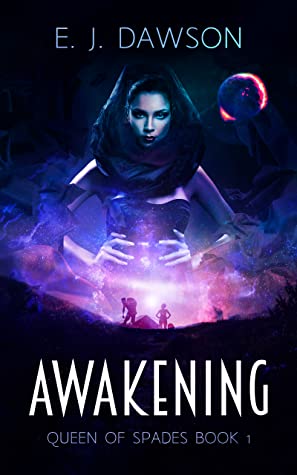
But I decided to self-publish my trilogy Queen of Spades so I had more control over the release date of the books, and the characters within them.
I have a much more active involvement in my own work rather than the publisher. I do something pretty much every day to market or work on the recently published first book in Queen of Spades trilogy, Awakening. Whether it’s on a blog or retweeting a review, I’m very proactive in the day-to-day process from the point of creation to the continuation of marketing.
For Behind the Veil, the process is much slower, and I need to do little until asked for the developmental and copy-editing. The editor at Literary Wanderlust has other authors she works with and so it’s my responsibility to step up when she’s ready with my work, and not worry about it when it’s not my turn. Once the work is published, I’ll take a more active role, and use my self-publishing marketing skills to help fill any gaps in the marketing plan for Literary Wanderlust.
For many writers, even those with big five publishers, there’s little to no marketing budget. You have to have a proactive approach, be ready to have something consistently going on with your book, advertise it, talk about it, put it on social media. Finding a balance between spamming and promotion is tricky, which is why it’s best to find a platform you’re comfortable using day in and out, so when you market a book you have people interested in you and what you have to say.
What are a few of your best tips for taking on self-publishing compared to traditional publishing?
Be prepared to work hard. Be satisfied with writing a book. Above all, be patient.
These easily apply to both self-publishing and traditional, and the thing to remember about each one, is that there is a difference between being a writer, and wanting to make a profession out of a hobby. Think of all the artists, woodcarvers, knitters, musicians and actors you know.
For many, it’s just a creative outlet. The saying that everyone has a book inside them is a little misleading because for self-publishing they recommend getting a book out every 6 months to stay relevant.
Some people only have one. That doesn’t mean their book is any less valued or important than a writer with a trillion ideas. Find what suits you. Do you have a lot of stories, or just one? Chances are if it’s just one, for now it’s your whole world. You’ll polish it and spend time on it, and take the greatest care reviewing it until it glows. This is the kind of manuscript that you can look at getting an agent for or even publish with an independent press.
But if you’re prepared to do the work, make sure your writing is properly edited, developed and marketed, and you have lots of story ideas, then look into self-publishing. You never know what you may find or how much you enjoy it.
 Scott Vandervalk